Health and Safety Policy Statement

Health and Safety Policy Statement

Halfords is committed to delivering good health and safety management and practices, recognising that people are its most important asset.

Our priority is to run Halfords with the protection of the health, safety and welfare of all people that are affected by our activities, being at the forefront of all our decisions.
Our commitment is to have a reputation for health and safety that exceeds expectations within our industry and amongst our peers.
Health and Safety Objectives

  • Promote a positive health and safety culture within Halfords, sponsored and endorsed by the Executive.
  • Strive for industry-leading compliance with all applicable health and safety legislation
  • Guarantee that suitable and sufficient resources and manpower are available to enable Halfords to fulfil its statutory requirements.
  • Ensure sufficient competent health and safety advice is available for all parts of Halfords.
  • Proactively identify hazards, assessing and managing the risks for all activities and locations.
  • Provide a safe working environment for all our colleagues, contractors and visitors, and to work towards an injury free working environment.
  • All colleagues are given sufficient training, information and supervision to allow them to carry out their roles competently and without risk to health and to challenge unsafe behaviours.
  • Ensure appropriate safe systems of work and equipment are provided for all colleagues to work safely, as required.
  • Engage colleagues in the decision-making process by regular consultation.
Henry Birch's signature

Henry Birch
Chief Executive Officer

Jo Hartley's signature

Jo Hartley
Chief Financial Officer

Paul O'Hara's signature

Paul O'Hara
Chief People & Property Officer

1. Health & safety organisation

In order to live our philosophy of “each accountable, all responsible” everyone in Halfords has responsibility for ensuring the safety of colleagues, customers and others impacted by our business. Specific roles, responsibilities and reporting lines are detailed below:
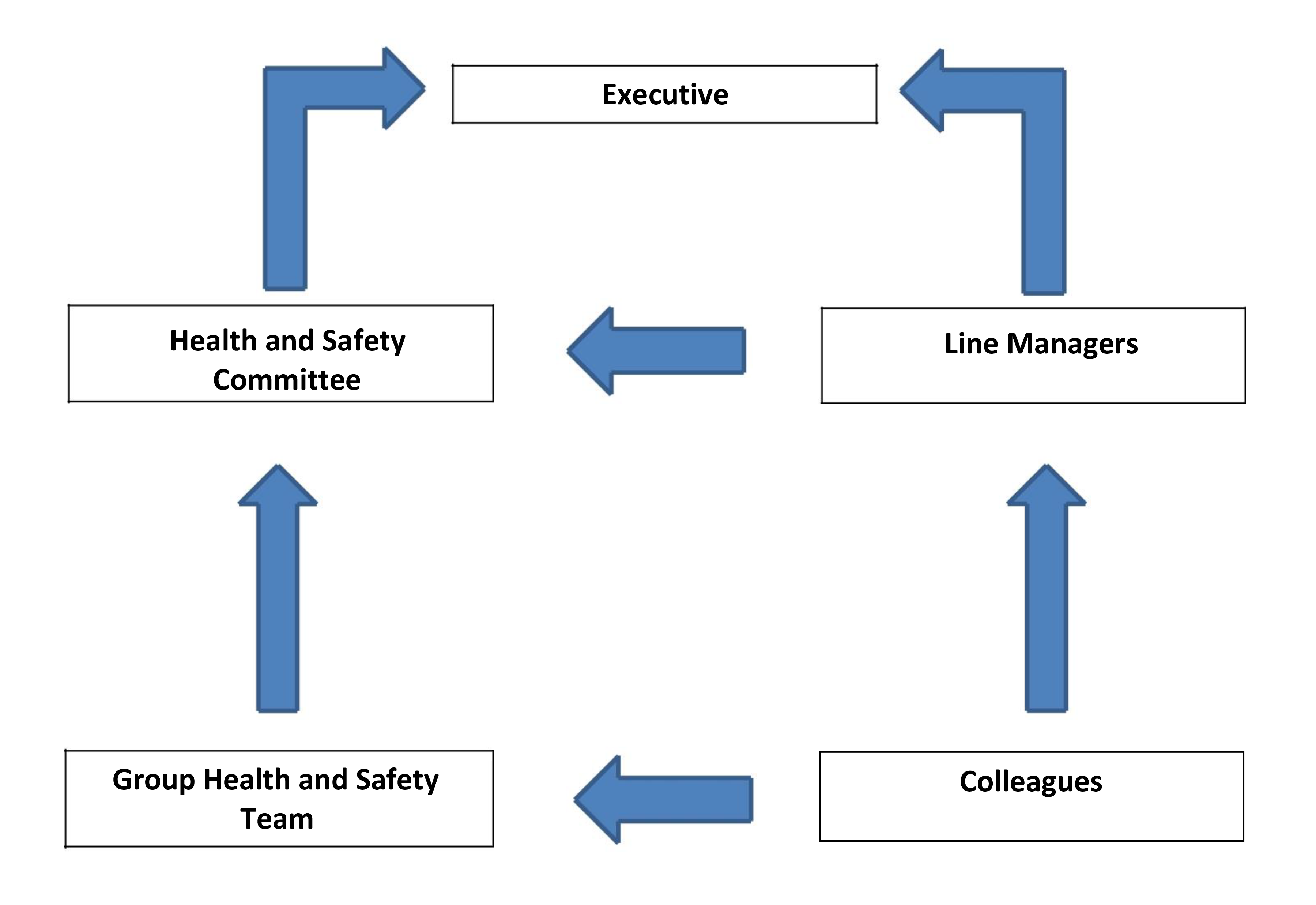
Flow diagram for the Group Health and Safety Policy

1.1 Role of the colleague

Role of the colleague

All colleagues have an obligation to take reasonable care of themselves and others who may be 
affected by their actions or omissions. Specifically, they have a responsibility to:

  • ensure that they make themselves familiar with, and conform to, Halfords’ Health & Safety Policy;
  • conduct their work in a safe and responsible manner, ensuring they comply with all guidance or appropriate safe systems of work provided by the company;
  • ensure that they wear and look after appropriate safety equipment as issued by the Company; 
  • ensure that the health, safety and welfare of themselves and others is not put at risk by their own acts or omissions;
  • report any accidents, near misses, activities or conditions that they believe are unsafe to their Line Manager as soon as possible;
  • ensure that they fully understand the risks and controls associated with a given process or task they are undertaking; and
  • ensure that if they do not believe that appropriate action has been taken following the reporting of a health and safety issue, that they:
    • refer the matter back to their Line Manager;
    • report the issue to Health & Safety Team; or
    • contact the Whistleblowing Hotline

1.2 Role of Line Managers

Line Managers are responsible for the health, safety and welfare of their colleagues, visitors, onsite contractors and the general public who may be impacted by the company’s activities. Line Mangers with functional responsibility for a building, are also responsible for the overall safe working practices for that site.

Specifically, Line Managers must:

  • ensure that they are aware of Halfords’ Health and Safety Policy and procedures;
  • ensure that no colleague commences work or contractor is allowed onsite until they have received an induction that covers emergency and evacuation procedures;
  • ensure that colleagues carry out their roles in a safe manner and receive appropriate training;
  • ensure that measures are in place for maintaining records of any health and safety training given, in line with the appropriate operations procedures;
  • not, under any circumstances, issue an instruction to a colleague, which if acted upon, may put the health, safety and welfare of colleagues or others in jeopardy;
  • assume accountability for the health and safety performance of the areas of Halfords for which they are responsible;
  • assume responsibility for ensuring that any accidents, incidents or near misses are appropriately dealt with, reported and investigated promptly; and
  • assume responsibility for ensuring that all work activities are subject to a risk assessment and that the risk assessments are completed and updated in line with changes to Company processes or physical requirements.

Further guidance can be gained from the Health & Safety Team. 

1.3 Role of the Executive

The Executive must lead by example in making Halfords a safe place to work and will:

  • recognise that each member of the Executive has direct responsibility for the area under their control;
  • ensure that health and safety is considered in all relevant decisions, and that it is done so with importance equal to that of any other factors;
  • enforce the ownership of health and safety management throughout the Company; 
  • actively encourage all colleagues to play their part in keeping Halfords a safe place to work;
  • guarantee that suitable and sufficient resources and manpower are available to enable the Company to fulfil its statutory requirements;
  • appoint the Chief People and Property Officer to be the designated executive with specific responsibility for health and safety;
  • review the health and safety performance of the Company at least quarterly through the Risk Committee; and
  • empower the Health & Safety Team to bring to a halt any activity which it considers unsafe and presents a risk to health and safety or property.

1.4 Role of the Health & Safety Committee (HSC)

The HSC is a formal sub-committee of the Executive that will meet on at least a quarterly basis and will:

  • co-create and agree Halfords’ Health & Safety Policy, framework and standards to be released to the Company in line with legal and Halfords’ requirements;
  • share good practice and lessons learned from across Halfords;
  • ensure that adequate measures are in place to ensure that health and safety policies and practices are reviewed, and their effectiveness measured and audited;
  • review remedial actions recommended by investigations following significant breakdowns in health and safety policies, procedures and controls;
  • be responsible for signing off amendments to health and safety policies and procedures;
  • agree and approve specific health and safety policies and procedures;
  • review the progress of action plans implemented in support of both Company objectives and operational initiatives; and
  • drive continuous improvement in all areas to prevent - so far as is reasonably practicable - any unplanned losses affecting colleagues and those who may be affected by our operations and activities.

1.5 Role of the Health & Safety Team

The Health & Safety Team is responsible for promoting health and safety best practice across Halfords and ensuring that the Company continues to meet its statutory obligations. Specifically, it will:

  • advise the Company on what legislation applies to its activities, and provide guidance on what actions are required for compliance;
  • facilitate auditing the Company to ensure compliance with both regulatory requirements (e.g. the Health & Safety at Work Act) and internal processes;
  • monitor, assess and report the performance of Halfords with regards to health and safety to the HSC on a quarterly basis;
  • assist Line Managers in the identification of control measures appropriate to the level of risk identified in risk assessments undertaken; and
  • either instigate or assist managers in investigating reports of unsafe actions or conditions and, where necessary, take the appropriate actions to mitigate or eliminate an identified risk. In exceptional circumstances, this may take the form of ordering the immediate cessation of operational activities deemed to be unsafe.

2. Health & safety working practices

Before any significant change in normal Halfords practices or before the launch of a new Company process, activity or project, suitable practices and procedures will be implemented to reduce health and safety risks to an acceptable level. These will include the following:

2.1 Risk assessment

  • All Line Managers with site responsibilities must ensure that, as a minimum, the following risk assessments are performed:
    • a general workplace Site Risk Assessment;
    • a Fire Risk Assessment;
    • a Manual Handling Risk Assessment; and
    • a Display Screen Equipment Risk Assessment.
  • The relevant Line Manager must ensure that these risk assessments are reviewed and updated either annually or when there is any significant alteration to working practices, management or the environment in which colleagues work.
  • Where a specific health and safety risk may exist with regards to an existing or new business process or working practice, then an appropriate risk assessment must be performed.
  • Where the risk assessment has highlighted a need for corrective or remedial action, the manager of the Company area affected, is responsible for ensuring these are carried out.
  • No risk assessment shall be considered complete until corrective or remedial works have been completed and the manager responsible for that area has signed it off.
  • The completed risk assessments must be communicated and made available to all affected colleagues, the Health & Safety Team and, if required, the appropriate regulatory bodies.
  • All risk assessments shall be subject to audit. Risk assessments found not to be suitable and sufficient by the Health & Safety Team will be deemed incomplete.
  • Where required, appropriate training in the risk assessments process will be provided to Line Managers.

2.2 Safe systems of work

  • If a risk assessment identifies - as a control measure - that a task must be performed in a particular manner, the process must be documented. This process will be known as a Safe System of Work (“S.S.O.W”). The manager of each Company area is responsible for ensuring that safe systems of work are prepared where necessary, and prior to the commencement of work activities.
  • Safe systems of work must adopt the following style guide;
    • follow a logical, step-by-step process flow;
    • be written clearly;
    • where appropriate, include graphics or pictures;
    • include a list of key safety points; and
    • include a list of ‘what If’ actions where applicable.
  • Safe systems of work should be communicated out to all relevant and affected colleagues, and it is the Line Manager’s responsibility to ensure that colleagues understand the content of “SSOW”, and records of training are maintained in accordance with local procedures.
  • Safe systems of work are to be stored both in electronic and hard copy format in each area of the Company to which they relate. Where failure to follow a safe system of work may lead to injury, a copy should be prominently displayed in the relevant area.
  • Safe systems of work form part of the health and safety management system for Halfords. Failure to comply with the Company arrangements for health and safety may result in disciplinary action being taken.

2.3 Training requirements

  • Line Managers are responsible for ensuring that all colleagues receive appropriate health and safety training.
  • When assistance is required in the identification or delivery of appropriate training, guidance should be obtained from the Health & Safety Team.
  • Where any incident, accident or near miss is attributable to a failure to follow procedures, as instructed, then refresher training must be completed before allowing the colleague involved to resume their duties. This training must be recorded.
  • The HSC will review the effectiveness and compliance with health and safety training initiatives and programmes and will approve any significant amendments to training methods and budgets.

2.4 Inspections

  • Any manager, who is responsible for a building (e.g. Facilities Manager, Site Manager) is required to ensure that all plant and equipment is identified, inspected and maintained, in line with both statutory requirements and the manufacturer’s guidance, by a competent person.
  • Managers with site responsibility are also responsible for ensuring that documentary evidence of inspections completed are maintained and are available on request. If required, the Health & Safety Team will advise what level of documentation is appropriate. It will be the responsibility of the manager responsible for the site to arrange the correction of any shortfalls or defects highlighted during an inspection.
  • Whilst responsibility for completing elements of routine inspections may be delegated, overall accountability for their correct completion and required remedial actions remains that of the relevant manager.
  • The Health & Safety Team will advise the Company of any additional inspections required over and above those recommended by manufacturers or required under statutory obligations.

2.5 Other policies

  • All records of training, accident report forms and any other records containing personal details shall be handled and stored in accordance with the Company’s Data Protection and Privacy Policy and Records Management Policy.

3. Health & safety monitoring systems

In order to ensure we create a safe working environment and identify how we can continuously improve health and safety performance; we need to measure and monitor the effectiveness of our health and safety policies and procedures. This will be achieved through our monitoring, investigation and reporting processes.

3.1 Monitoring

  • The Health & Safety Team will conduct a combination of announced and unannounced health and safety audits.
  • Line Managers will ensure safe working environments by conducting scheduled daily, weekly, monthly and annual health and safety checks in line with Company policy and procedure.
  • Line Managers are responsible for initiating the necessary disciplinary action in response to colleagues engaging in frequent or deliberate breaches of health and safety policy or any act or omission that directly places the health and safety of themselves or any other person at risk.
  • Colleagues are to be encouraged to bring to the attention of their Line Manager anything they believe to be unsafe.
  • Line Managers are directly responsible for taking the necessary action to correct any activity, practice or behaviour identified as unsafe.
  • The HSC will review health and safety performance across Halfords on at least a quarterly basis.

3.2 Investigation and reporting

  • All accidents, incidents and near misses must be reported to the manager responsible for the area of the Company in which the event happened at the earliest opportunity.
  • The manager responsible for the area of the Company in which an accident or near miss occurs, is responsible for ensuring an appropriate investigation is completed and that any required action or improvements are implemented.
  • The Health & Safety Team must be notified of the findings of investigations following all accidents or near miss incidents.
  • All RIDDOR incidents must be reported to the HSC.
  • Accident, incident and near miss statistics will be reviewed on a quarterly basis by the HSC.

4. Review

This Health and Safety Policy will be reviewed by the Group Head of Health Safety and Environment annually.