We use cookies to improve your experience on this website and analyse site traffic. To find out more please review our cookie policy.


Please use the arrows to navigate to the sub pages
23 March 2026
TYRES AT UK LEGAL MINIMUM TREAD DEPTH ‘AS DANGEROUS AS PHONE USAGE’ ACCORDING TO ACADEMIC STUDY
● A vehicle with worn tyres - at the legal limit of 1.6mm and which would pass an MOT - will typically take longer to stop than if the driver is using a mobile phone at the wheel
● At 70mph, worn-but-legal tyres add 27m to stopping distance - around six car lengths
● Using a mobile phone at the same speed typically adds 15m
● Experts urge drivers to treat worn tyres as seriously as mobile phone use
● VIDEO: See the stopping-distance difference between worn tyres and phone distraction
● Researchers, TyreSafe and Halfords say the current 1.6mm legal limit may be too low
For immediate release on 23 March 2026: A new academic study has revealed that tyres worn to the current legal UK limit of 1.6mm - and that would pass an MOT - could increase stopping distance more than if the driver is on their phone. The new figures have suggested that the UK tread limit may may be to low.
The in-depth study, conducted by the Director of the Centre for Automotive Industry Research at Cardiff University and commissioned by Halfords, found that on average, phone usage increases reaction times for braking by 0.5 seconds.
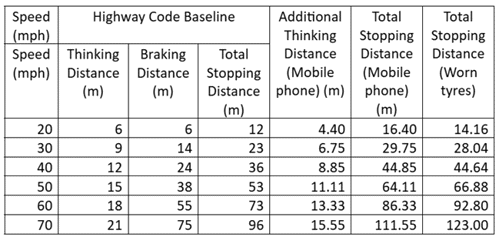
At 70mph, this will increase stopping distance by an additional 15.55m. However, if the car has worn (but shockingly, still legal) tyres with 1.6mm of tread, it will take an additional 27m to stop vs a car with tyres in good condition. That’s an additional six car lengths.
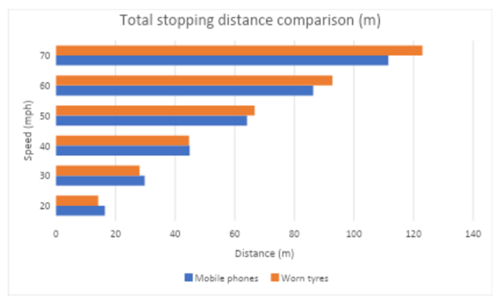
This means that a car travelling at 70mph, with good tyres will take 96m to stop - meanwhile if the driver is on a phone, stopping distance will increase on average to 111.5m. However, if the vehicle has worn-but-legal, tyres stopping distance increases to 123m.
To clearly demonstrate this, Halfords has created a video showing the difference in stopping distance. The film shows the effects of both worn tyres and mobile phones use versus a vehicle with tyres in good condition.
The research found similar increases in stopping distance between worn tyres and mobile usage in speeds up to 40mph. However above this, tyres were found to increase stopping distance more than phone usage.
Government data shows an increase in the number of deaths or serious injuries on our roads as a result of dangerous tyres - rising from 147 in 2022 to 172 in 2024 (the most recent data available).
The findings are being released to encourage a change in the current attitudes towards the dangers of worn tyres - just 7% of drivers believe worn tyres can be more dangerous than using a phone at the wheel.
When informed that at speeds above 40mph, the increased stopping distance from tyres with 1.6mm of tread is greater than the average increased stopping distance when a driver is using a mobile phone over half (53%) of respondents in the survey say they were surprised by this.
The findings are being used to demonstrate the current rules on tyre tread may need to be reviewed with a greater focus on enforcement (similar to mobile distraction) so motorists pay more attention to the safety of their tyres.
Professor Wells and Halfords recommend that drivers change tyres once they get to around 3mm of tread.
The research showed that nearly a third of motorists (31%) believe that the current limits on worn tyres should be raised, with over half (53%) saying that driving with worn tyres should be penalised with tougher penalties.
The research also highlighted a wider lack of knowledge when it comes to tyre safety. Just 28% of motorists are aware that the current legal limit for tread depth is 1.6mm. More than four in 10 (42%) guessed incorrectly, while 29 per cent didn’t know the correct measurement at all. In addition, 28% say they are not confident they would recognise when their own tyres needed replacing, with 10% admitting their tyre tread and pressure is checked only when their motor is being serviced and 30% testing this just ‘a few times a year’.
Professor Peter Wells, Director of the Centre for Automotive Industry Research at Cardiff University said: “The impacts of phone usage and worn tyres have never been compared before and the study suggests that purely from a stopping distance perspective, the impact of worn tyres is generally worse. Of course the impact of phone usage will be variable, but the findings offer a strong guideline as to the dangers. Drivers need to be aware that tyre performance begins to become impaired long before they reach the legal limit.”
Adam Pay, Managing Director of Autocentres and Mobile Network of Halfords, said: “Most drivers know using a phone behind the wheel is dangerous. What this research shows is that tyres worn down to the current legal limit can actually have an even greater impact on stopping distance. The legal minimum shouldn’t be mistaken for a safety benchmark. When tyres reach that point their performance is already significantly reduced, which raises an important question about whether the current limit is where it should be.”
Stuart Lovatt, TyreSafe Chair added: "This study highlights a critical and often overlooked factor in road safety: the physical relationship between tread depth and stopping distances. While the UK legal limit remains 1.6mm, the data shows that at motorway speeds, the impact of worn tyres on braking can be even more significant than driver distraction. We encourage all motorists to treat tyre maintenance with the same seriousness as they do mobile phone use. Whether a driver chooses to replace their tyres at the 3mm mark recommended by some experts or waits until the legal limit, the priority must be regular safety checks. As tyre technology evolves to meet new wet-braking standards, staying informed about your vehicle's actual performance is the best way to keep our roads safe."
Halfords is also using the research to highlight to motorists the ongoing dangers phones present. Two-fifths of drivers reveal that they make or receive calls while driving and 39% say they use their mobile phone for playing music while they drive. And over half of (54%) admit having to rely on using Sat Nav on their phone when they drive - meaning the phone is always nearby.
Motorists who want to check on their tyres and save on the cost of their next MOT can sign up to Halfords Motoring Club for free at www.halfords.com/motoring-club where they will receive a £5 voucher as well as a £5 discount off their MOT, plus a free ten-point car safety check worth £15. They can also get a free tyre check any time at any Halfords or National Tyres and Autocare garage.
Ends
For further information please contact Halfords@vccproar.com or 0207 932 3693
Research study commissioned by Halfords and undertaken in February 2026 by Professor Peter Wells, Director of the Centre for Automotive Industry Research at Cardiff University. Study assumes wet surface conditions.
Consumer research carried out by One Poll amongst 2,000 UK motorists, 5-9 March 2026.
About Halfords
Halfords is the UK's leading provider of motoring and cycling products and services. Customers shop at 404 Halfords stores, 3 Performance Cycling stores (trading as Tredz and Giant), 604 garages (trading as Halfords Autocentres, McConechy's and National) and have access to more than 200 mobile service vans. Customers can also shop at halfords.com and tredz.co.uk for pick up at their local store or direct home delivery, as well as booking garage services online at halfords.com.